

Amazon Prime Video Direct
For more general information on data collection in Redbird, check out: Getting Started With Data Collection
This guide explains how to set up access and collect earnings data for content hosted on the Amazon Prime Video media streaming platform. You will need to use your Amazon Prime Video credentials to log in to the platform.
If you cannot see the Amazon Prime Video collection app in the left-side panel on the workflow canvas, refer to: Enabling Collection Apps Guide
Creating a Collection
- Double-click on the node to enter configuration mode
- Click the pencil next to Configuration Name to name your collection
- Click the Gear Icon next to the credentials drop-down to register your credentials. Click Add New Login and enter a reference name for the credentials under Name, then enter the username and password. You will then need to set up the 2FA code forwarding, see here for instructions. Once set up, click Done. Note, you can enter more than one set of credentials if you wish.
- Type in the Account Name (verbatim and case sensitive) that you would usually select from the dropdown at the top of the Amazon Prime Direct User Interface. Write it as it appears in the dropdown itself.
- Select the Report Type you wish to use from the drop-down from the following:
- General Earnings
- General Payment and FX Detail
- VOD Content Usage*
- VOD Earnings
- VOD performance metrics
- Linear Earnings
- Linear Performance Metrics
- Subscription*
*for these reports you need to specify the channel name here if there is one and the granularity e.g. Monthly or Weekly.
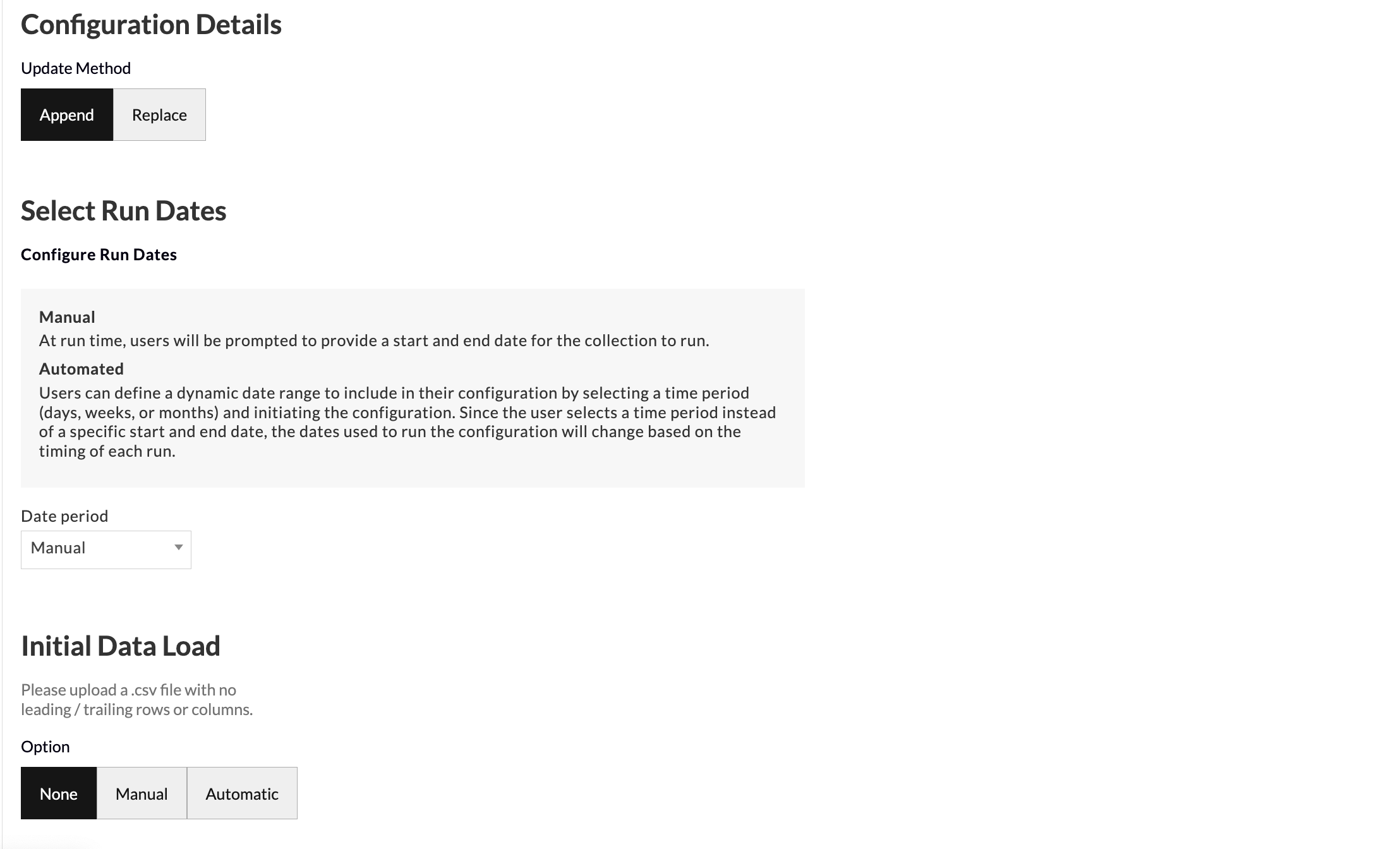
- Update Method allows you to select how you want your data to aggregate when you run future data pulls. Append keeps the historical data and adds the future data pulls below. Replace deletes the historical data and generates the new data in its place.
- Select Run Dates allows you to set the input date period method for your data collection as manual or automatic.
- When set to manual, at run time, users will be prompted to provide a start and end date for the collection to run.
- When set to automatic, users can define a dynamic date range to include in their configuration by selecting a time period (days, weeks, or months) and initiating the configuration. Since the user selects a time period instead of a specific start and end date, the dates used to run the configuration will change based on the timing of each run.
- Initial Data Load allows you to upload historical data in bulk as a one-off in the event that you have the data saved on your computer. You can upload your data as a CSV file with no leading/trailing rows or columns and Redbird will run future data collections using the configuration that you set up in previous steps.
- Click Done
Running a Collection
- Click on the node.
- In the right-side panel click Run
- If date selection is set to manual, then the workflow will be stopped for you to input dates. Click Review on the node.
- Select the Start date and End date of the period you would like to cover.
- Click Back to Workflow
- Click Continue on the node.
Updated 5 months ago
Did this page help you?