

Meta Ads
For more general information on data collection in Redbird, check out: Getting Started With Data Collection
This guide explains how to set up access and collect data from the Meta Ads platform. Advertisers can serve their ads on properties like Facebook and Instagram, and the API provides a programmatic way to pull data.
If you cannot see the Meta Ads collection app in the left-side panel on the workflow canvas, refer to: Enabling Collection Apps Guide
Creating a Report
-
Double-click on the node to enter configuration mode
-
Click the pencil icon at the top to name your collection
-
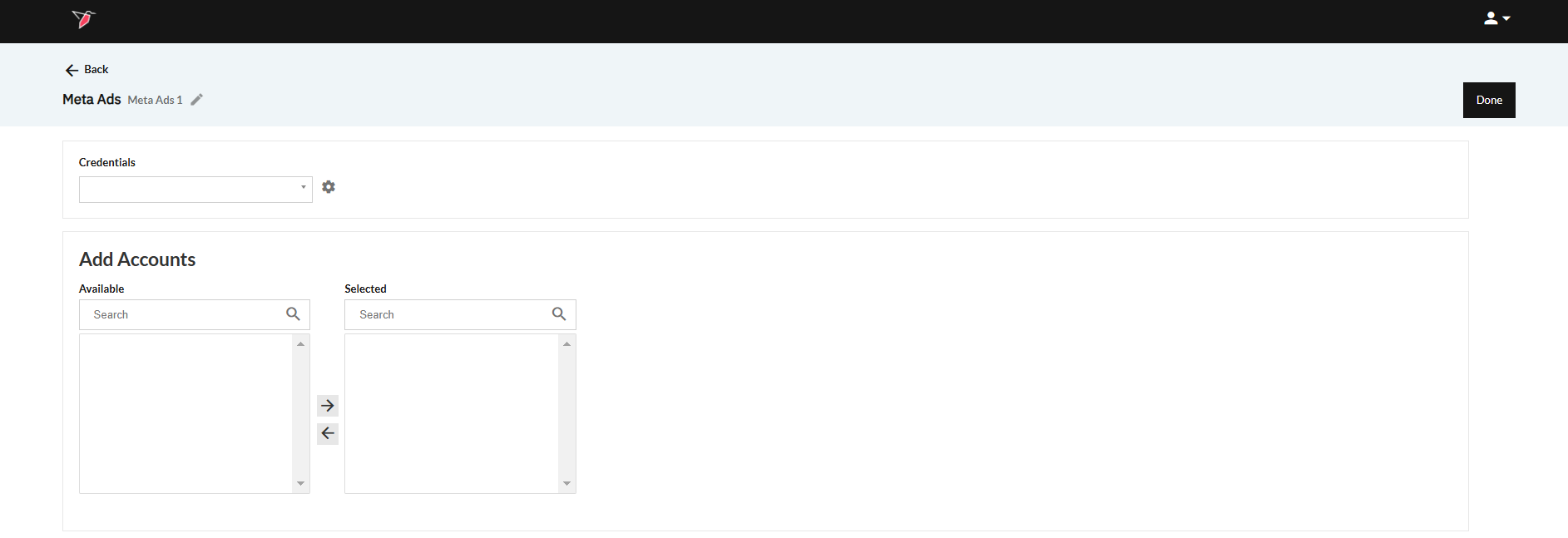
Select the website credentials that you need to pull data from under the Credentials drop-down. If needed, you can add credentials during this step by clicking the gear icon.\
-
If you have Full Control of your Meta Business account and Ad Accounts, you can request a System User Token by clicking the System User Token toggle. This token will never expire, and it will allow you to be more specific about what accounts Redbird will have access to.
-
If you do not have Full Control of your Meta Business accounts and Ad Accounts, you will need to request a User Access Token (default). This token will expire in 60 days. To refresh your credentials, restart the process by clicking Login with Facebook.
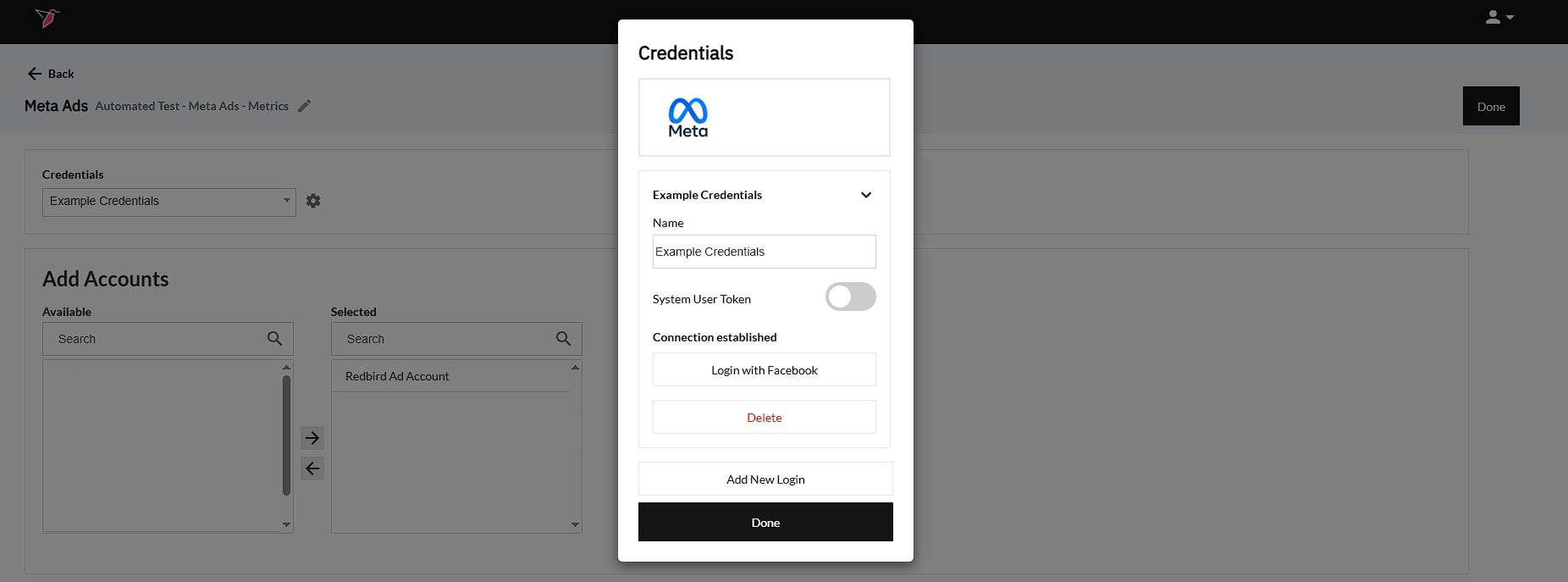
- Upon clicking the button, a modal will pop up, prompting you to log in with your Facebook credentials. Once you've logged in, follow a series of steps where you'll grant read access to Redbird for the ad accounts that you have access to. On the final step, you can review the permissions granted to Redbird.
- Once you've finished the authorization process, you can select your newly updated credentials in the Credentials dropdown
-
-
In the Add Accounts section, you should see the Facebook ad accounts selected in the previous step in the Available box. Using the left and right arrows, select the ad accounts that your configuration will pull data from.
-
In the Details section, there are a series of dropdowns to choose from -
-
- Action Attribute Windows - Use this dropdown to specify your Action Attribute Windows. Read more about them here.
- Date Aggregation - Use this dropdown to determine whether your report will be aggregated at Daily, Weekly, or Hourly level. The default selection will aggregate your report over your report's date range
Certain breakdowns and metrics are not available with Hourly reporting
- Level Aggregation - Use this dropdown to determine what level of detail your report will have. By choosing Ad, Adset, Campaign, and Account your report will be limited to certain dimensions. For example, Ad IDs will not be available when you set your level to Account as it is further down in the Ad hierarchy.
-
-
In the Action Breakdowns, Breakdowns and Fields sections, the available options will populate in the Available boxes. Select the options that you need and click the top arrow to move it to the Selected boxes.
-
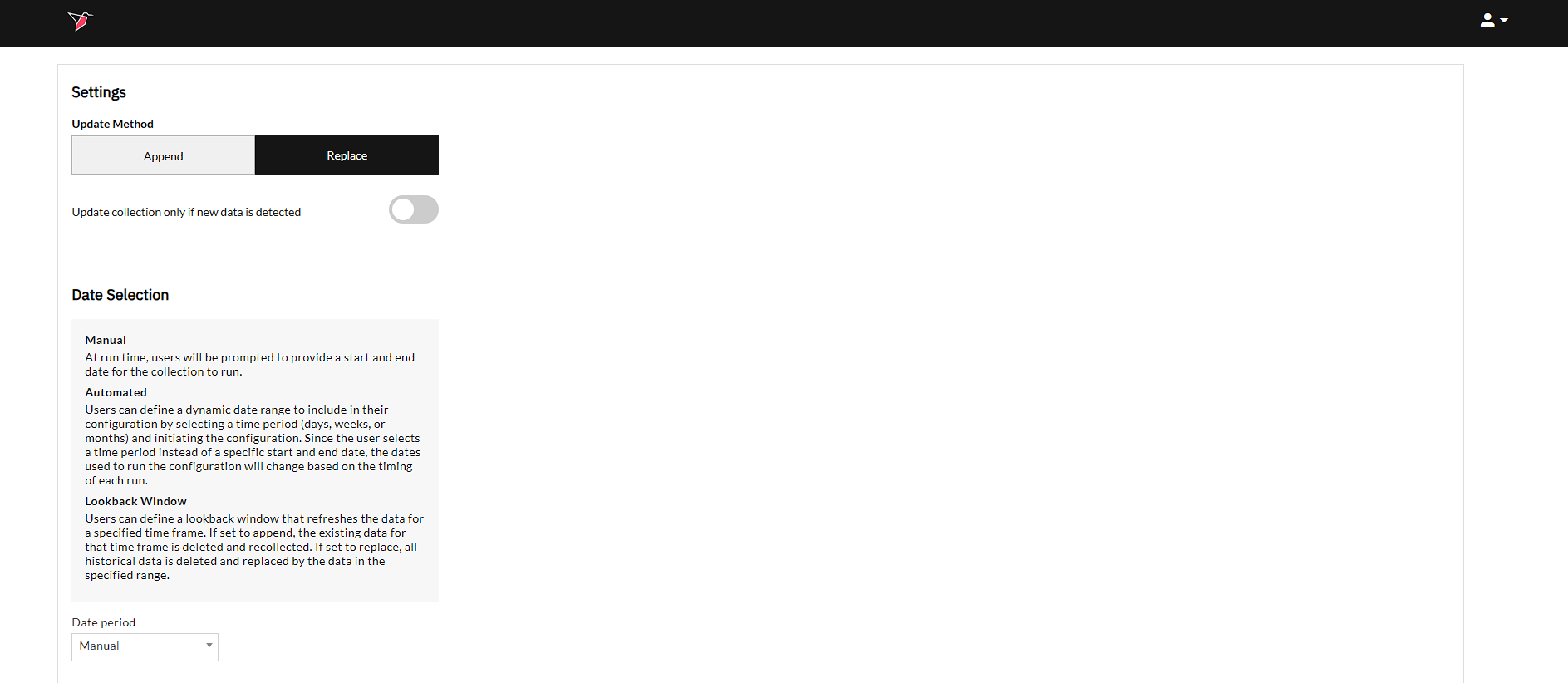
The Update Method allows you to select how you want your data to aggregate when you run future data pulls. Append keeps the historical data and adds the future data pulls below. Replace deletes the historical data and generates the new data in its place.
-
Date Period allows you to selected between a Manual date range or an Automated date range.
- Manual: At run time, users will be prompted to provide a start and end date for the collection to run.
- Automated: Users can define a dynamic date range to include in their configuration by selecting a time period (days, weeks, or months) and initiating the configuration. Since the user selects a time period instead of a specific start and end date, the dates used to run the configuration will change based on the timing of each run.
- Lookback Window: Users can define a lookback window that refreshes the data for a specified time frame. If set to append, the existing data for that time frame is deleted and recollected. If set to replace, all historical data is deleted and replaced by the data in the specified range.
-
Initial Data Load allows you to upload historical data in bulk as a one-off in the event that you have the data saved on your computer. You can upload your data as a CSV file with no leading/trailing rows or columns and Redbird will run future data collections using the configuration that you set up in previous steps.
-
Click Done
Pulling Action Stats
An action is activity that happens on your ad (for example, someone watches your video ad) or as a result of your ad (for example, someone views your ad and then downloads an app). To read more about them click here. Following the below steps to pull your action metrics
- In the Details Section, make your selections from the three dropdowns. Actions numbers will change based on Action Attribute Windows, so make careful note on that one.
- In the Action Breakdown section, make selections on different ways that you want to break down your Action metrics by. Most importantly, select Action Type as one of your action breakdowns so that you can see the general categories.
- For the Breakdowns and Fields sections, make your desired selections. If you're trying to stitch your action metrics together with general media metrics, you should be sure to include any of the same columns (e.g. Date, Ad Name).
Facebook institutes API row limits that may cause your collection to fail. Best practice is to break up your report into smaller date ranges and append them together using the Configuration Details setting
Running a Collection
- Click on the node.
- In the right-side panel click Run
- If date selection is set to manual, then the workflow will be stopped for you to input dates. Click Review on the node.
- Select the Start date and End date of the period you would like to cover.
- Click Back to Workflow
- Click Continue on the node.
Updated 7 months ago